4.1.1 |
THE NANAPOLARITY CATENA |
Neutral-inclusive thought is
characterized by three critical steps.
When taking the neutralistic starting point (rather than the relevantistic
one, as we have done in
the Book of Fundamentals), the
first step is that of assigning the highest normative value to the
neutral predicate, and lower
values to unneutral predicates.
The second step is the realization that there are two sides to the
neutral ideal:
neutrality proper and the striving
for neutrality, which is not neutral in itself. And the third step is the
recognition of the inseparability of neutral and inclusive thought.
It is on the grounds of this model that every symbol which is,
strictly speaking, only neutralistic represents the ideal of
inclusivity as well.
The distinction between neutrality proper and the striving
for neutrality corresponds to the distinction between an original
catena and its
neutral-directedness catena.
While neutrality proper
(ananicity) is the central predicate of
an original catena, the striving for this neutrality is the positivity of
the neutral-directedness catena of such an original catena. (Its
neutrality is
nan-neutral-directedness, and its
negativity un-neutral-directedness.) This neutral-directed
(nanapolar) striving
is purely directional and can therefore be represented by an
arrow. In a one-dimensional space in which neutralness is
represented by a point, the striving for neutralness has two
directions: one from the one extreme to the center, and the
other from the opposite extreme to the center.
Since the catena is analogous to a one-dimensional space (that is, a line),
a line with a distinct point in the center can be looked upon as a catena
(of which the neutrality corresponds to the distinct point).
The positivity of the neutral-directedness or
nanaicity catena can be
superimposed on this image of the original catena by adding an arrow which
stands for the striving for neutrality
thru positivity
(increase) and an arrow which stands for the striving for neutrality thru
negativity (decrease).
The two arrows will meet in the one point representing the neutrality of
the original catena.
The central sign which emerges in this figure looks like a multiplication
sign (X), and the image has now become two-dimensional.
Altho the total
figure consisting of the straight line and the central sign
( ---X--- ) is still rather primitive, it does already take hold
of both aspects of neutral thought, namely the recognition of the special
status of
(ananormative) neutrality and
the significance of all (ananormative) striving for neutrality.
The simple figure formed by two arrows meeting in the middle
is a visual and/or tactual symbol of neutrality, nanapolarity
and the positivity and negativity of the original catena thru
which neutrality can be achieved. It represents the whole basic
or other original catena and the nanapolar predicate related to
this catena. We shall call this concrete symbol "the
(Nanapolarity) Catena" or "nanacatena" for short. (Since
the symbol itself, or a concrete object, is not a catena, (Nanapolarity)
Catena is a name to be capitalized.) Where the nanacatena is
present, this is a nonfundamental sign of the belief in ananicity
and nanaicity. (Nonfundamental in that it cannot be compared to
the two fundamental symbols of
the DNI.)
The nanacatena is not the symbol of a nanaicity or
neutral-directedness catena, because such a symbol would not only depict
neutral-directedness but also nan- and un-neutral-directedness.
The center of the Nanapolarity Catena symbolizes neutrality; the left of
it positivity —the further to the left the more positive— and
the right negativity —the further to the right the more
negative— or vice versa.
To indicate the degree of negativeness and positiveness we can make the
'line' thicker and thicker as we move from the neutral point.
The degree of unneutralness is now also visualized or tactualized (that
is, made tactual or tangible).
Negative unneutrality and positive unneutrality must not be differentiated
in a nanacatena, for they have exactly the same value according to the
ananorm.
Suffice it that one is on the
sinister, the other on the
dexter side of the center.
The original left and right lines which have become surfaces
may be bordered by a straight line or by a (part of a) curve
such as a circle.
If these surfaces are bordered by straight lines, the nanacatena consists
of two equicrural, but not equilateral, triangles of which the top angles
meet in a point marked by the central sign of the nanacatena (the X sign
which emerges when an arrow is mirrored).
The central sign can only stand out when the base of the identical
triangles is made considerably shorter than the sides.
Also if the surfaces are bordered by curves, or parts of curves, this
central sign has to show clearly.
The surfaces themselves (depicting the unneutralities) may be either
filled in or left blank.
When filled in the variant of the nanacatena may be called "solid",
when left blank "open".
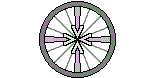
Figure S.4.1.1.1
shows a number of open and solid variants of the nanacatena, and
one intermediate, dashed variant. If the surfaces are not achromatic
(white, grey and/or black), they should represent all colors of a
spectrum with (yellowish) green as the central color at either side
of the sign of neutrality.
Every variant of the Nanapolarity Catena must comply with the
basic rules for this figure in order to be recognizable as a
symbol of neutralism, and therefore also of inclusivism. For
people who have the power of sight the Catena may represent the
DNI in a visible way by displaying it on a piece of paper or
fabric, for instance; for people who have a sense of touch the
Catena may represent the DNI in a tangible way, such as by means
of a sculpture or a carving in relief. It is not necessary to
present one, technically and esthetically entirely worked-out,
final shape of the nanacatena. Within the frame given here several
possibilities remain.
What is important is that the Nanapolarity Catena is —irrespective
of individual variations— truly symbolic of the quintessence of the
DNI.