1 INTRODUCTION
Only few people are familiar with a curious new development in an
area where computer art and literature overlap. Like all computer art
the use of data-processing machines to write poems began as a game.
Perhaps, it still is a game, but then one with a prospect not
necessarily less promising than that of non-verbal forms of computer
art and not less challenging than traditional forms of poetry. Under
certain conditions computer-generated poems deserve indeed to be taken
seriously, as I hope to show.
While describing the present state of affairs in computer poetry
and its potential for the future, I will not exclude the possibility
that the reader may not even agree that computer poetry in general, or
a certain type of it, is poetry at all. But I do not find this
question interesting as a not inconsiderable part of what I am going
to discuss is undeniably verbal art. Interesting, then, is whether
this form of verbal art called "computer poetry" is original, is
grammatical, knows how to cope with pronouns, uses a random generator
throughout or in special cases only, works graphic or aural effects,
enables or could enable the writer to express feelings or ideas,
allows or could allow for concrete interaction with the reader, and so
on and so forth. It is questions of this kind with which I will deal
in this paper.
2 TYPES OF COMPUTER POETRY
In the Longman Dictionary and Handbook of Poetry Myers and Simms
define computer poetry as "a recently developed form of poetic
composition in which data-processing machines are used to generate new
sequences of words" (1985, 62). They distinguish two types of computer
poetry. In derivative computer poetry, they say, "the programmer
gives the computer lines of existing poems and the computer alters
them in a systematic way" (62). Systematic is not the right term,
when in practice all computer poetry programs use somehere somehow a
random generator. And there is no reason why the data provided by the
programmer should be lines (nor are they in the only work cited by
Myers and Simms): they may be anything from single words to longer
phrases, clauses or whole lines.
The other basic type is labelled "formulary computer poetry" by
Myers and Simms. Here 'the programmer gives the computer a syntactical
structure and a list of words to fill in the structure', according to
Myers and Simms (62). But this formulary aspect does not at all
distinguish this type from derivative computer poetry, which always
has to make use of a verbal or syntactic algorithm and of elements
which may or may not be words (instead of smaller or larger linguistic
units). I myself shall therefore differentiate between derivative
and original computer poetry. Original computer poetry does neither
imitate the structures of existing, non-computer-generated poems nor
copy their lexical contents.
Like practically all phenomena computer poetry can be classified
on the basis of several criterions, and differently classified on the
basis of a different criterion. Thus, in a work on language, texts and
computers the Dutch writer Boot distinguishes not two but three types
of computer poetry on quite a different basis.
Firstly, Boot says, there is the 'dice model' which makes use of
a random generator (1984, 259). In its simplest form its elements are
single words selected at random from a dictionary. As an example of
this type he gives the ten-line "LYRIC 3205" by Pete Kilgannon, even
though the fourth and the eighth, and the fifth and the ninth lines
'happen to be' exactly the same. Its first two stanzas are:
judy gotta want upon someone.
wanna sadly will go about.
sammy gotta want the thief him but the
every reason. real distance carry.
(Boot 1984, 261)
That this original poetry --if "poetry" it can be called-- makes use
of a random generator is not really typical of it; even less so when
this use is selective. What is really typical of it is that it is
ungrammatical, that it refuses to recognize any word-order.
The second type of computer poem is, according to Boot, the
'sentence variation model' (262). Here the programmer begins to
realize that a poem is not just a collection of words, but that there
are certain rules to be observed; rules which govern their
combination. Boot mentions Milic's computer program RETURNER as an
example of this model. Myers and Simms mention the same program as an
example of derivative computer poetry. I will discuss RETURNER at
greater length in the next section. However, I should already point
out that also Milic's program uses several devices for securing
randomness, and that it is not this but its grammaticality which
distinguishes it from Boot's first type.
As an example of the third type, the so-called 'filter model',
Boot mentions a program called "BORANPO". This program, which produces
semi-grammatical poetry in the Dutch language, is based on pattern
recognition as a specific aspect of artificial intelligence (264). The
computer is thus made to do, it is claimed, what poets themselves do
when perceiving reality from a very personal point of view, that is,
when 'filtering' it. The filter chosen in the program is one of colour
designations. The data fed into the computer are not taken from a
single poem, as in Milic, but from the complete oeuvre of the poet who
is to be imitated -- an imitation which results in a reasonable degree
of grammaticality as well. Clearly, BORANPO is, like RETURNER, a brand
of derivative computer poetry.
In Disappearing Through the Skylight, a book about culture and
technology in the twentieth century, Hardison gives several examples
of computer poetry, including haiku-like poems and a poem generated by
a program called "MUSESTORM" (1989, 271-78). While the haikus were
written at a very early stage of computer poetry, MUSESTORM is of a
later date. It produces non-grammatical iambic pentameters and is an
exception to the general rule that computer poetry is not arranged in
regular beats. As is evident from Hardison's examples too, computer
poetry is not metrical and does not rhyme. This is not so of
necessity, for it is certainly possible to write a computer program
which produces metre and/or end-rhyme in a text which is grammatically
correct. But in addition to the spelling of data this would require
their pronunciation to be fed into the computer too, including
syllabication and stress. To my knowledge such programs which make use
of both orthographical and pronunciational data do not (yet) exist.
Coming forth from a verbal algorithm a computer poem will almost
automatically show syntactical repetition and the recurrence (with or
without variations) of significant phrases. Being unmetred and
unrhymed as well there is therefore little against describing the
visual-aural form of contemporary computer poetry as 'free verse',
especially when it makes use of additional devices of free verse, such
as the recurrence of image patterns, variation in rhythm, and special
typographical or grammatical features.1
My distinction between 'derivative' and 'original' computer
poetry corresponds with Hardison's distinction between the 'classic'
and the 'expressive' use of a new technology. In the former case the
computer is 'used to do more easily or efficiently or better what is
already being done without it', in the latter the capacities of the
computer are used 'to do previously impossible things' (236). In other
words: derivative computer poetry and the 'classic' use of computer
technology are imitative, whereas original computer poetry and the
'expressive' use of this new technology are innovative. It stands
to reason that original computer poetry requires greater imagination than
its derivative cousin, even though both may be in free verse.
Moreover, it unambiguously conceives of computer poetry as a process
and mode of literary composition in its own right, with its own medium
and potentialities. That is why, on the whole, I will pay
significantly more attention to original computer poetry, but not
without first having studied in more detail Milic's work, which at
present is probably the best-known example of English-language
computer poetry.
3 TURNER AND MILIC'S DERIVATIVE COMPUTER POETRY
In 1965 Alberta Turner published a non-computer-generated poem
called "Return" which was, as she later wrote in 'Returner
Re-turned', 'a calender sequence of short, concrete sentences in
thirteen two- and three-line stanzas describing each month of the year
and beginning and ending in January' (1971, 387). The first two
stanzas of Return were:
Hemlocks are nearly round,
Deer paw the pond,
My dog squirts the porch post.
Last night the snow wouldn't take tracks,
But apple twigs are cut
Higher than porcupines.
(387)
In 1971 Louis Milic took the phrases of this already existing
poem and put them through a series of transformations in an experiment
to generate computer poetry. Clearly, Milic did not only copy the
words of Return but also its stanzaic structure of two- and
three-line units. However, in Milic all lines are independent clauses
(either direct statements or direct questions), which is not the case
in Turner. The first two stanzas of Milic's RETURNER read:
In the morning crowbars will be nearly round.
Separate blankets never step again.
Tomorrow I will ring him through the willows.
Do mice sometimes become like deer at home?
Hemlocks hiss from salad to salad now
But yesterday he often pawed all the apples at the milk
pan.
(Turner 1971, 389)
At first sight this poetry looks quite original in its
surrealism, and the reader may be not unwilling to see some more
stanzas, although, perhaps, not all one hundred of them. But on closer
examination the output turns out to be considerably less creative.
Thus, every other stanza has the same structure with no fewer than six
to twelve fixed words which keep on returning again and again at
exactly the same place. Not only are all sentences simple sentences,
all of them, and therefore also all lines, also have the same basic
form: subject + predicator (+ subject attribute / direct object) with
one, two or three adverbials added. If the words in the adverbials are
not completely fixed, they are chosen from a very small set of two or
four common adverbs. Subjects and direct objects are not realized by
noun phrases of which the same head could be a noun or a pronoun, as
in natural language, but the head of these noun phrases is either a
noun (selected from the database) or a personal pronoun.
In describing the patterns used in Milic's and other computer
poetry I will put the actual words in the texts in CAPITALS and
UNDERLINE them if they are fixed ones, that is, not chosen out of
a set of two or more data. Moreover, I will try to give the narrowest
description which fits the programmatic subdivision of a line, but not
include information which can be inferred from the structure of the
clause in question. For example, a verb preceded by a noun (phrase)
and followed by nothing else than an adverb (phrase) must be
intransitive and lexical. I do not have to add this. In my analysis of
sentences I will follow English Syntactic Structures (Aarts and
Aarts 1982). However, it is not at all necessary that the subdivision made
by the computer program coincides with a grammatical one, let alone
with the syntactical distinction between functional constituents
(subjects, for instance), the categories by which they are realized (noun
phrases, for instance) and word classes (such as the class of nouns).
All odd stanzas in Milic, then, answer to the following pattern:
(1) IN THE MORNING + noun phrase with a noun as head + WILL +
APPEAR / BE / BECOME / SEEM / TURN + adjective phrase
(2) Noun phrase with a noun as head + ALSO / NEVER / OFTEN / SOMETIMES +
verb in the present tense + AGAIN
(3) LAST NIGHT / TODAY / TOMORROW + pronoun + verb phrase (a verb in
past/present/future tense) + pronoun + THROUGH THE WILLOWS
Again judging by the thirteen stanzas published in Turner's
'Returner' Re-turned, all even stanzas answer to this pattern:
(1) AT HOME + noun phrase with a noun as head + ALSO / NEVER / OFTEN /
SOMETIMES + APPEAR / BE / BECOME / SEEM / TURN in the present tense + LIKE +
noun phrase with a noun as head
(2) Noun phrase with a noun as head + verb in the present tense
+ FROM SALAD TO SALAD NOW
(3) YESTERDAY / CAREFULLY + pronoun + OFTEN / SOMETIMES + verb in past/
present tense + noun phrase with a noun as head + AT THE MILK PAN
Possible variations in these two patterns are: that one line may
be left out (the second or the third one); that a direct statement may
be turned into a yes/no question with word-order inversion (five times
out of 35); that occasionally a conjunction (AND / BUT / SO / YET) is put at
the beginning of the second or third line.
Although Milic strictly separates noun phrases with a noun as
head from those with a personal pronoun as head, his computer program
produces personal pronouns at random and cannot cope with their
deictic function. A random pronoun insertion is possible and can be
interesting to some degree but not without first having determined (at
random or not) the pronominal focus of the poem: is it written in the
first person singular or any other person? Return was written in
the I-form, and presumably, RETURNER follows this assumption, if only
because six noun phrases used as data have MY in them: MY DOG / BOWL /
PORCH / ROCKER / SISTERS / CHILD. But even a poem written in the I-form
needs other possessive pronouns to refer to other living beings and
their bodily parts, qualities or possessions, as Return itself
demonstrates: THE BOY TURNED HIS ANKLE (388). Does this become
something like I TURN HIS ANKLE in one of the later stanzas of
RETURNER? Pronoun management can make or mar a computer poetry program
and I will return to this issue in section 6.
Typographical arrangement or graphic representation always plays
a role in written poetry, if only to separate the one poem from the
other by means of empty lines, but also to indicate a stanzaic break.
Turner and Milic use typographical devices like these which are common
in poetry and also outside literature. Neither of them uses other
graphic devices such as indentations or different typefaces or
locations of words. Nonetheless, the length of text lines, too, is
important in the graphic representation of poems. Thus, Return,
Turner's original, continues for 34 lines of which no more than three
are longer than 38 characters. (The longest line is 45 characters).
Milic's RETURNER, on the other hand, has much longer lines. In the
first thirteen stanzas there are several lines of 53 and 58 characters
long, and the maximum length of a line is (at least) 60 characters. I
mention these rather trivial unpoetic facts, because they have made me
wonder whether the author of RETURNER has ever asked, or has ever had
to ask, himself the question whether to use a 40- or an 80-character
text mode for the screen of his computer monitor.
4 KROL'S ORIGINAL COMPUTER POETRY
In 1971 the Dutch novelist and poet Gerrit Krol made an elaborate
proposal for a computer program which would be able to produce poetry.
He called it "APPI": 'Automatic Poetry by Pointed Information'. What
he offered at the time was no more than a method for creating
computer poetry. Eight years later, however, he published four poems
generated by an actual program developed by himself. Unlike Milic's,
Krol's computer poetry is original in that it is not based on earlier
poetry: data and structure are both completely new. In discussing
Krol's poems here I will mainly follow my own analysis of them, as I
have been able to study neither Milic's nor Krol's computer program
itself. Although Krol's poetry is in Dutch, I shall discuss it as if
it were written in English. Unless I mention it specifically the
difference between the two languages is not relevant to what follows.
Translated as literally as possible, the first six lines of one
of Krol's computer poems are:
SHE SOMETIMES STOPS AND SHE OFTEN HEARS IT , BECAUSE
SHE LOOKS FORWARD TO IT . WITH THOSE NAILS
WITH THOSE LOCKS BEFORE HER EYES
YOU THINK THAT SHE LOOKS FORWARD TO IT , BUT
I SEE THAT YOU BELIEVE THAT
SHE IS AFRAID AND PERHAPS SHE WANTS TO SWIM
(Krol 1979, 59)
Judging by the poems accompanying Krol's essay six constitutive
elements have been used in generating them. They appear together in
varying order and frequency. I will describe three of these elements.
The basic constituent is a type of clause which appears again and
again in most, although not in all lines. Its structure is:
SHE (the subject) + an adverbial or (DOES) NOT + a predicate as a
single data, consisting of a predicator with or without a subject
attribute or direct object.
It may be succeeded by a conjunction (AND / BECAUSE / BUT / FOR / IF /
OR / SO THAT), usually to link it with another element of this type.
It may be preceded, once or twice, by:
I / YOU / SHE + THINK / BELIEVE / SEE (a verb of propositional attitude in the
present tense) + THAT.
Another element which can be distinguished is an adjunct which
always starts with the words WITH THOSE. Itself being a
prepositional phrase, it has (part of) a noun phrase as variable data
(LIPS / NAILS / LOCKS BEFORE HER EYES).
Because only the main element fulfils the criterion that it
requires the input of data not given by the program itself, that it
has at least one subject or predicator, and that it can be used
independently of the other elements, Krol's computer poetry cannot be
said to be based on more than one pattern. The fact that one line may
contain as many as four elements only confirms that these elements are
not different patterns in themselves. The 'pattern' which remains is
one with beginning nor end, without any fixed (maximum) number of
elements, external data or lines. Yet, somehow Krol makes his texts
end after 11 or 13 lines. Thus broken off quite arbitrarily they are
then presented as complete poems. No other conclusion seems possible
than that his program runs without any pattern at all.
It is highly questionable whether Krol's pronoun management
allows for as much variation as allowed for in the order of his
constitutive elements. The overwhelming use of SHE almost submerges
the I in the first three texts and wholly submerges it in the last
one. This is alright for a poem written in the third person, but what
if one wants to write a poem in the first person, not about oneself
but about someone or something else? A poet should be able to choose
from different perspectives, and to make a clear choice. Such a
choice is also bound to affect the variable data, as LOCKS BEFORE HER EYES
will not be correct anymore where the reference is not to one girl or
woman other than the one speaker him- or herself or other than the two
or more speakers themselves. Of course, it is theoretically possible
to make a new database for every change in situation or subject, for
every time the person spoken about is not of the right gender, but
such an awkward and annoying inflexibility is unnecessary. A good and
user-friendly poetry program should allow for the use of at least the
most common pronouns with the same database.
The only graphic effect in Krol's computer poetry is, perhaps,
that all his output is in capitals. He does not care about
indentations, nor about empty lines to differentiate between stanzas
or other parts. Although his Dutch lines are in general no longer than
42 characters, two lines are up to 49 characters long as the result of
a space, comma, space and conjunction added at the end. Like Milic,
Krol pays little attention to typographical arrangement.
Literary sound effects, too, are lacking. In the data, let alone
in the lines produced, no attention has been paid to the relationships
between vowels and consonants or to their hypothetical absolute
qualities. If there is rhythm, it is, like rhyme or assonance and
alliteration or consonance, accidental. This is not to argue that
poetry must rhyme or alliterate or have other aural devices. However,
with no graphic or phonological effects at all, nor special diction,
poetry becomes rather prosaic, something Krol must also have felt when
he wrote that the poetic lines in his 'texts' have to be searched
for (1979, 58).
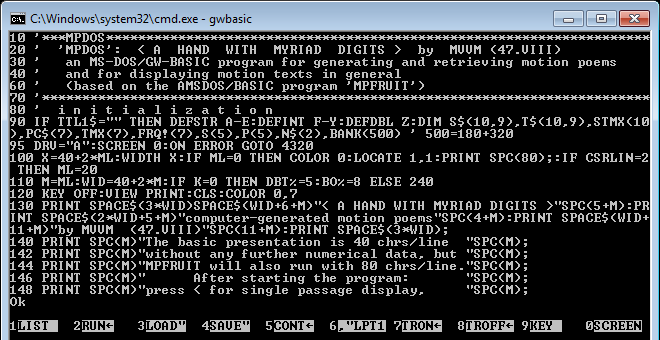
5 A HAND WITH MYRIAD DIGITS
Enthralled by the idea of verbal computer art I started a project
of original computer poetry myself a few years ago. I gave it the name
A Hand With Myriad Digits. In this name
both hand and digit have
several meanings. There is the normal human hand with five fingers or
'digits', but there is also the computer as a 'hand' useful for making
calculations and building structures, as something of this time that
can lend us a hand, almost literally when the hand is that of a robot
it controls. And digits does not only refer to fingers and toes,
but also to the basic numbers of systems of arithmetic: 0 to 9 in the
denary, 0 and 1 in the binary system. A digital computer is hardly
anything else than a tool working with 'ten thousand', that is, a
very, very great number, of binary digits or 'bits'.
One of the first things which come up when the possibility or
phenomenon of computer poetry is approached in a systematic way, is
that of the (maximum) length of lines to be allowed. This length
should be established even before any patterns are chosen and the
maximum length of data can be determined. A modern computer
configuration often has two text modes: one with 80 characters on a
line, and one with 40 characters which are twice as big. For a number
of reasons I decided to go ahead with the larger characters and a
maximum width of 40 on the screen. It is no problem to show poems of
this width on an 80-character screen, or to print them on paper with
twenty spaces on both sides.
Given that the computer monitor is, like paper, a graphic device,
making use of visual effects, I further decided to develop a number of
patterns on a graphic basis. The length of these elementary
patterns had to be no more than 255 characters, the maximum length of
one string of characters in BASIC, the computer language I use. Part of
the available characters I reserved for other purposes, so that the
maximum number of text lines for each pattern became 5, rather than 6.
The identity of the patterns I based on the indentations of their
lines: 0-, 3- or 6-space indentations. These choices led to the
development of seven patterns, some of them with several subpatterns.
It is important, I believe, that I use a much greater number of
patterns than Milic and Krol; it is not important that I use seven of
these patterns or that their basis is primarily graphic.
My patterns were the visual skeletons to be fleshed out with
meaningful linguistic data. Unlike Milic and Krol I refused to make
use of fixed words: they are fine so long as the reader does not
realize they are fixed, after that they soon become boring, if not
outright disappointing. Only in one pattern does my program use a few
lexical words of its own, but even in that pattern a choice is still
made out of a set of three internal data, that is, data which are part
of the program. All the other internal program data may be considered
grammatical: AND, OR, ALL (as determiner), THAT (to link a subordinate
clause), (OF) THIS (to replace THAT when the clause is empty),
(SOME)ONE, (EVERY)ONE and all personal, dependent possessive,
reciprocal and self-pronouns, with the notable exception of it(s)
and itself. (TOO or EITHER may be added to a self-pronoun as in
ONE MAY FEAR OR BEFRIEND ONESELF TOO or in YOU ALMOST NEVER WALK HAND
IN HAND WITH YOURSELF EITHER.)
So far as the data in the data files, that is, the external data,
are concerned, I never started out with the assumption that they had
to be single words and that a powerful machine would then combine them
in such a way that it would ultimately produce a work of Shakespearean
eloquence, if not in an intelligent, then with a bit of luck in an
accidental way. This would have been what might be called "the
small-to-large procedure". I stayed closer to the safer 'large-to-small
procedure' in which the variable data can also be whole clauses or
sentences. In this latter approach computer poetry programming itself
is more or less a process rather than an attempt to deliver a final
product at once. As the program develops and becomes more intricate,
the external data, too, become more and more specific, and clauses and
larger phrases may eventually disappear in favour of smaller phrases
consisting of no more than a few words only. At present the data in
A Hand With Myriad Digits still vary from single words to whole
sentences, divided over 17 sets of 9 data. If not empty, each of these
153 external data will have to appear at least once in a poem to make
it complete on paper. (On the monitor the poem generated never ends.)
Because of the variety in data the contents of my patterns show a
reasonable degree of structural diversity as well. In principle the
minimum number of variable data is three, the maximum number five in
one pattern. If syntactically acceptable, a data may be empty in which
case the actual number of data in a pattern may be as little as one.
With one, two or three data a whole pattern could cover only one line.
(HE WORKS HAND IN GLOVE WITH THEM is an example.) As a matter of fact
empty data are a strong device in computer poetry, because they can
create unexpected variants within patterns and especially on the
interfaces between successive patterns.
I will confine myself to discussing only two of the patterns in
my program. They occur in the following seven lines which were
generated as part of a stanza. Like all examples I show it without any
post-editing:
IN A MIRE OF UNTOLD MATERIALISM
I TRY NOT TO LOSE MY EQUILIBRIUM
BAD THINGS WAX AND WAX AND RUN TO WASTE
A BIRD IN THE HAND BELONGS IN THE BUSH
THE DUSK OF GREED'S DOOM GATHERS OVER
THOSE DEVOURING THEIR OWN DELIGHTS
COULD THE GREENWOOD BUT WAIT IN ME
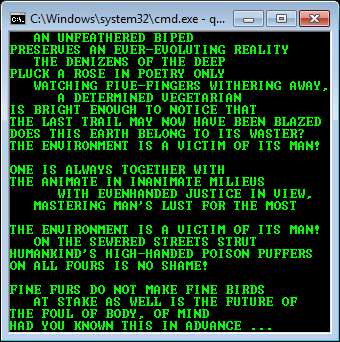
There are ten data in these lines: seven have been read from the
data file for Five Fingers Grasping The Earth, a poem about the
natural environment, while I, MY and ME are as internal data part of
the program. The second data (I) and the third (TRY NOT TO LOSE +
EQUILIBRIUM) are printed on one line because the syntax of the pattern
allows it and because together they are not over 40 characters in
length, including the indentation at the beginning and the space in
between. If two data are too long to be printed on one line the second
data is not split up, however, as is common usage in prose. Thus, also
these four lines of the same poem and pattern appeared on my monitor:
IN A MIRE OF UNTOLD MATERIALISM
AN UNFEATHERED BIPED
DETERMINES THE WEAL OR WOE OF THE WORLD
BAD THINGS WAX AND WAX AND RUN TO WASTE
(instead of AN UNFEATHERED BIPED DETERMINES in line 2 and THE WEAL OR
WOE OF THE WORLD in line 3). Had the second data been I, then the
second line would have contained nothing else than I. The program does
not follow ordinary word-processing practice not only because it saves
no space here, but more so because it would spoil the structural
transparency of the text as determined by the internal and external
data together.
The pattern which runs from the first to the third of the seven
lines shown above contains an adjunct (here an adverb phrase), a
subject (any noun phrase), a predicate as one data, and a second clause
as one data. The third data belongs to a set of 'one-place relational
phrases'. This is a programmatic category of data which are always
preceded by a noun phrase and in no pattern followed by one as part of
the same clause, although they may include a noun phrase themselves.
If (the last part of) the one-place relation expresses a propositional
attitude, then the phrase of which it forms part will automatically be
followed by THAT, unless the fourth data is empty. Thus, the second
and third lines could also have been:
I FEEL THE IMPORT OF THE FACT THAT
THE ENVIRONMENT IS A VICTIM OF ITS MAN!
It is therefore only clauses which, by adding THAT, can realize the
function direct object after a verb of propositional attitude which
are suitable to fill the fourth slot in this matrix. In a noun phrase
such as THE FACT THAT THE ENVIRONMENT IS A VICTIM OF ITS MAN such
clauses are appositive and realize the function postmodifier.
The second pattern runs from the fourth to the last line. Also
THE DUSK OF GREED'S DOOM GATHERS OVER is programmatically treated as a
'one-place relational phrase', but now with the noun phrase following
rather than preceding it. At the moment this noun phrase differs from
the one in the first pattern in two or three respects. Firstly, it
cannot be singular or a pronoun because of grammatical problems with
data such as AND YET, THEY ARE PART OF NATURE, . Secondly, the data in
this set have a negative emotional value whereas those in the other
set have a neutral or positive one. Such a qualitative difference
between data sets enables the user of the program to convey feelings
of sympathy or antipathy by means of the database. I will return to
this issue in section 7.
With one insignificant exception the only literary sound effects
generated by my program are those which result from the repetition,
sometimes frequent, of whole data or of whole lines containing several
data. Although these repetitions deepen the meaning of these lines or
data, they are at random and irregular. For the rest it is the way the
external data have been filled in by the user of the program which
produces or does not produce special phonological effects. While the
program itself does not generate them, their creation is made
possible, because any data may be as long as 32 to 40 characters, so
that there is every opportunity of creating aural effects within the
data themselves.
Due to the computer's versatility computer literature can be
made interactive, offering the reader the opportunity to become a
writer, 'co-writer' or 're-writer'. Thus, while the original database
is prepared before running the program, it should be possible to alter
it during the running of the program. Neither Turner in describing
Milic's program nor Krol in describing his own speak about interaction
with the user or reader in this sense. In A Hand With Myriad Digits
the reader can alter any of the external data while running the
program, without changing the data file itself. At the moment the same
program can be used interactively in two other respects. Firstly, in
one's choice of person. There are ten possibilities. For example, by
pressing 0 a new canto will start in the "I"-form; by pressing 1 in
the "you"-form. Secondly, the program is also interactive in that the
reader can select any of the seven patterns to the exclusion of the
others, or in a different frequency distribution of patterns. These
interactive features are meant as extras to allow for personal
expression and to encourage creative action without discouraging the
passive reader; they are not meant to give the writer who takes the
lead carte blanche in bad poetry.
6 TOWARDS TEXTUAL COHESION
How can a machine that does not think, and does not have the
foggiest idea of the meaning of words, produce not only verbal art but
also a text which displays enough cohesion to be of interest to the
readers, and even to challenge them to interpret it in a creative way?
I will not try to give a full answer to this question; instead I will
concentrate on the minimum standard to which computer poetry must live
up if it is ever going to be an acceptable form of literature.2
The most important thing is that textual cohesion presupposes
lexical cohesion, and that this will aready have to be demonstrated by
the database. Technically speaking any data which is not too long will
do, so long as the computer is not provided with a dictionary of the
language that can warn the user/writer that, for example, the head of
what is supposed to be a noun phrase is not a noun but a verb. And
yet, the grammatical correctness of the computer output does not at
all guarantee any degree of meaningfulness beyond the level of
sentences. To achieve this it is, first of all, necessary to develop a
context by choosing a theme or a subject. The data entered (anything
between single words and complex sentences) must then relate to one
another by embroidering on this theme.3 This
applies especially to original computer poetry, for one may assume that
in derivative computer poetry the lexical cohesion of the database should
be the same as that of the original non-computer-generated poetry.
If the computer's handling of data does not show consistency in
attitude, lexical cohesion will still not result in textual or
narrative cohesion. Consider, for example, a poem about intimate
feelings of which some of the data are I, MEN, WOMEN, LOVE and HATE,
then theme and context are quite well-established so far as these five
data are concerned. A randomizer, however, will choose the following
clauses with equal frequency: I LOVE MEN, I HATE MEN, I LOVE WOMEN, I
HATE WOMEN. Clearly, a poem haphazardly strewn with these or similar
statements would not succeed in creating a coherent picture of the
first-person narrator even though the grammar is correct and even
though all the words are contextually related. There are several ways
to go about this problem. The easiest 'solution' is, obviously, to
leave either LOVE or HATE out of the database, and, perhaps, also
either MEN or WOMEN. In the next section I will propose a more
fruitful approach to the question of how to deal with the
user's/writer's attitude to a subject.
Besides a theme which must be more or less clear and an attitude
which must be more or less consistent, there is a third standard to
judge the actual or potential cohesion of a computer poem by, namely
its pronoun management. Only in its simplest form is pronoun
management a question of grammar. I now refer to the changes which are
necessary because of the use of a singular instead of plural noun
phrase, or because of the use of a different pronoun in a clause. In
my own databases all data are entered in the third-person plural, but
in one- or two-place relational phrases which follow a noun phrase the
third-person plural (THEY, THEM, etc.) is automatically made to agree
with that noun phrase, which realizes the subject of the clause. If
TRY NOT TO LOSE THEIR EQUILIBRIUM, for instance, is preceded by, say,
SHE, then TRY is transformed into TRIES and THEIR into HER. The former
change is definitely grammatical but the latter only if to lose one's
equilibrium is considered one expression.
What to think of such data as THEY ARE A NAIL IN THEIR COFFIN? We
expect THEY and THEIR to refer, not to the same, but to different
people or things, also because otherwise it would have read "They are
a nail in their own coffin". But if the subject is I, should it, then,
become I AM A NAIL IN MY COFFIN? No, it should not: with I it could be
I AM A NAIL IN THEIR COFFIN, but ideally speaking the computer should
only generate THEY ARE A NAIL IN MY COFFIN. Nonetheless all these
alternatives are grammatically equally correct. (Note how differently
they define the first-person narrator's self-image!) A computer poetry
program must indeed change pronouns and verb forms where grammar or
the story requires it, yet not change them where this is
grammatically possible and the user/writer wants it that way. In the above
example THEY should be made into a fixed part of the data, whereas THEIR
may be variable.
But distinguishing variable pronouns within the data from fixed
ones may not be enough. By taking the third-person plural as standard
(and there are good reasons for doing so in English) Turner's MY DOG
would have to be entered as THEIR DOG or DOGS, Krol's LOCKS BEFORE HER
EYES as LOCKS BEFORE THEIR EYES. Grammatical number is still
problematic though: does THEIR DOGS have to be transformed into MY DOG
or DOGS? It seems that in the first person singular Krol's phrase
ought not to be LOCKS BEFORE MY EYE. Ultimately, therefore, also
variable plurals will have to be distinguished from fixed ones, which
do not change, regardless of context.
As we are now also dealing with requirements which are not only
of a grammatical but also of a more general nature, I would like to
invite the reader to have a look at the following lines generated at
the end of a canto in Five Fingers Grasping The Earth:
THE RESIDENTS OF THIS ONE REALM
HAVE TO TAKE TO THEIR HEELS FOR TOXICS
THE LAST TRAIL MAY NOW HAVE BEEN BLAZED
MAY I OFFER THEM
EXISTENCE AMONG FELLOW BEINGS
OR A FINGER OF THE EARTH
THE LOW OF HERDS IS HEARD NO LONGER
THE DUSK OF GREED'S DOOM GATHERS OVER
THE HAPLESSLY OVERCIVILIZED
IT RENTS IN TWAIN OUR SILENCE, OUR REST
(Lines 1-3 and 7-10 follow the two patterns discussed before; lines
4-6 follow a different pattern.)
In the above ten lines the program has made use of three
different 'noun phrase indices'. The first one is a 'clausal (noun
phrase) index' assigned to THE RESIDENTS OF THIS ONE REALM. It is a
purely pronominal index which has the value of the third-person
pronoun with which the noun phrase could be replaced. It only ensures
that the clause in which this noun phrase is used is grammatically
correct. Thus, THEIR in line 2, which is entered as a variable
pronoun, is not changed because its value is the same as that of THEY,
the pronominal value of THE RESIDENTS. The clausal index is a
grammatical feature confined to merely one pattern or textual unit, or
if a unit has two program-generated clauses to merely the first or
second part of that unit.
The other two noun phrase indices extend beyond the limits of a
single textual unit as determined by one of the patterns. Of these two
the 'referential (noun phrase) index' keeps track of the person(s),
personified or animate being(s) to which a singular or plural third-
person pronoun other than it at any time refers or would refer, if
used. Unlike first- and second-person pronouns, one and quantifiers
such as someone and everyone, third-person pronouns normally need
a particular reference in the text itself. Conversely, a noun or name
which appears two or more times at places very close together in the
text will normally be replaced by the appropriate third-person
pronoun, especially when there is no other noun in between which could
be replaced by the same pronoun. The function of the referential index
is precisely to make this possible in a text much longer than a single
clause or sentence without referring to the wrong being(s) or without
substituting the wrong pronoun for a noun or name. Thus, the third
noun phrase data selected by the randomizer in the text above was not
THEM or THEY (line 4) but THE RESIDENTS OF THIS ONE REALM. This phrase
was then replaced by THEM because the referential noun phrase index
still had the value of THE RESIDENTS. (Had the randomizer selected an
inappropriate third-person pronoun, it would also have been replaced
by THEM.)
At this stage of my program the referential index only relates to
nouns which are the heads of noun phrases entered as independent data
and used in more than one pattern. It does not deal with nouns or noun
phrases which appear as parts of longer data. However, in A Hand With
Myriad Digits it is typical of the independently used noun phrases
that their heads refer to persons or animate beings, and therefore the
proximity of other data with nouns in them is not likely to cause
confusion.
The third index at work in the above text is what might be called
the "focal (noun phrase) index". Having only the value of a pronoun
it is purely pronominal but nevertheless of great significance, for it
determines the pronominal focus or point of view of a canto, a finite
division of the poem (itself in principle infinitely long). There are
as many of these perspectives as there are pronouns. The pronoun
corresponding with the current value of this focal index will always
appear within clause data with a variable pronoun and in patterns
where two noun phrases consist of a pronoun only, unless the second
pronoun has the function of replacing a noun or name which would have
appeared more than once in the same or a nearby pattern. The focal
index of the canto of which the above lines constitute the end has the
value of the pronoun I, referring to a first-person narrator.
Therefore I appears with THEM in line 4. It does not reappear in the
last line in the form of MY, because that data was fed into the
computer exactly as it is printed here. Had the possessive pronouns
been THEIR though, and had they been variable, then they would have
been replaced by MY.
The focal index which determines the perspective of a canto has
no effect on pronouns which are governed by a clausal or referential
noun phrase index. Thus, MY in I TRY NOT TO LOSE MY EQUILIBRIUM (see
the previous section) does not replace THEIR because that text is
written in the first person too, but simply because the subject of the
clause is I. True, as the subject happens to be realized by a pronoun
I itself was selected on the basis of the focal index. Nonetheless,
THEIR is changed into MY on the basis of the clausal index. Had the
subject been THE DENIZENS OF THE DEEP then THEIR would have been left
unchanged in spite of the focal index, for the denizens of the deep
will not try not to lose my equilibrium. Also THEIR in line 2 above is
based on the clausal noun phrase index and not replaced with MY even
though the pronominal focus of the canto is I. Similarly, THEM in line
4 did not become ME or MYSELF because it follows the referential noun
phrase index.
Good pronoun management is a basic requirement for computer
poetry. Not surprisingly, Turner writes in her commentary on Milic
that 'the reader's frustration at RETURNER's pronouns does not
reinforce any perceivable unity in the poem' (396). Such a 'perceivable
unity' or textual cohesion can only be achieved, I believe, with
a carefully designed thematic database and a program that constantly
records and makes use of at least three pronominal values.
7 HOW PERSONAL OR IMPERSONAL?
There used to be a time, especially in the oral tradition it
seems, that a literary work of art was not so much the creation of one
individual as the creation of a whole community. But whether an
individual or communal undertaking, literature has always been something
personal in that it was the expression of the feelings and thoughts
of a person, a group of persons or a people. Will computer poetry now
herald the beginning of an era of impersonal literature in which
the expressing is meekly and diffidently left to machines? Or, will it
never be considered part of literature (at any rate by people) precisely
because it is impersonal? These are the kind of questions which
may be asked by those who take it for granted that computer poetry is
and must be impersonal. But their assumption is only justified to the
extent that, and so long as the computer programs that function as
intermediaries between human and machine are of inferior quality and
not yet fully developed. To say that computer poetry is not literature
is, then, like saying that poetry of inferior quality is not
literature, or no 'true' literature. It is not to say anything about
the impersonal role of the machine played in such poetry.
What is this role of the machine in computer poetry, and does its
being 'impersonal' detract from its worth?
First of all, a computer or computer configuration represents a
specific medium or a specific use of a medium: in its basic present-day
form it uses the screen of a monitor or a lap-top to display its
output. (Output printed on paper does not distinguish it from
traditional written poetry.) The text on such a screen can move by itself,
and be made to move faster or slower as the reader desires, which is
an essential difference with text fixed on paper. As Hardison points
out: "in spite of many classic applications, computer art has an
innate tendency to be kinetic and to exhibit itself on video screens"
(237). Furthermore, the text generated by a computer can be sent to an
electronic communication display and be shown to an audience rather
than to a single reader. By connecting the computer to a speech
synthesizer a poem can be immediately recited. Although such a rendering
may still sound horrid now, with the advance of technology it will
only improve. Not that the voice of a robot that can manage metre is
to be preferred to that of a human being with a feeling for rhythm,
but a speech synthesizer is a helpful instrument for the blind and
under certain circumstances for everyone else, except the deaf, as
well.
The second aspect of the role of the computer is that it carries
out instructions in a given order with a speed human beings could not
dream of. This processing speed too has increased astronomically, and
will continue to increase for the time being. And in spite of the
enormous speed at which the machine works it will stick to the
algorithm of the program without making mistakes. (The mistakes are
the programmer's!) To say that all this could also be done by hand is
to forget that we do not have the longevity to do as much as
accurately. Furthermore, the computer and the disks on which it stores
and saves its data have a gigantic and comparatively infallible
memory. To think that all this could also be remembered by heart (or
be found back somewhere on slips of paper) is to ignore that we lack
the mnemonic ability to do so, even though we may be a zillion times
more intelligent than the smartest computer. Therefore, it is little
interesting to note that a particular passage of computer poetry could
have been written by hand: looking at the passages in isolation all
computer poetry could have been written by hand, just as almost anyone
can remember a few numbers and make a few calculations without the
help of a machine. It is the totality of poetry which can be made to
issue at any time from a well-developed database and a serious
computer program together which cannot or hardly be parallelled by
human hands.
The difference between computers and human beings with respect to
speed and accuracy of calculation and with respect to their ability to
store, retain and retrieve information is, perhaps, merely a
difference in degree. There is, however, another aspect of the role of
computers in which their being impersonal is an essential prerequisite
of their functioning: they have the ability to randomize, to simulate
a random or chance selection of data and yield unbiased combinations
of such data. People simply do not have this ability. Ask them for a
random number between 100 and 1000 and they will say "451" or "638",
not "200" or "989". In the computer, however, these four numbers have
an equal chance of being selected. Pure chance lies on a continuum
midway between extreme alternation and extreme perseveration and
people tend to choose too much and too often for alternation when
asked for a random number or sequence of numbers.4
Computer poetry that uses a random generator has a stochastic
purity ordinary human beings (and therefore also chance poetry) can
never achieve (without dice or other means). The computer will combine
data or combinations of data they would not think of combining because
the combination is too obvious or too far-fetched or appears too often
(they believe). To understand this one should let the digits of denary
numbers correspond with single words, with shorter or longer phrases
or with whole lines, assuming that each set does not contain more than
9 data. If such data or combinations of data are whole lines, then the
computer generates poems in which lines are reinforced by repeating
them at random. Such a repetition of whole lines, but also of phrases
shorter than a line, may be boring and annoying if it happens too
frequently and if the data repeated are uninteresting. But it may also
give a new impetus to poetry by introducing a style that gravitates
less towards extreme alternation and more towards pure chance and
perseveration.
Let me illustrate this.
As a rule non-computer-generated poetry uses a line repetition
scheme of the type 12345.... Poems with refrains are of a type such as
12345/67895/... and an exception to this rule. In computer poetry,
however, a line repetition scheme may be 12210 (in which the fifth
line is deleted because of an empty data), for 12210 is not less of a
random number than 12345 or 53729. In computer poetry the norm is not
extreme alternation but pure chance and it is deviation from this
norm in the direction not only of perseveration but also in the direction
of alternation which needs a reason, and which, if there is one, will
provide the poem with additional meaning.
The computer's capacity to randomize without fear or favour is a
great asset so long as this same capacity is not used in developing a
character, an attitude, an idea or a message in the poem. Then it
produces the kind of inconsistency I have already alluded to in the
previous section, where a person has an equal chance of loving
something as of hating it. One could, of course, confine a database to
positive feelings such as love and confront the protagonist (the I in
a poem in the first person) exclusively with beings it/he/she loves,
or is permitted or supposed to love. To make a character stand out in
clear relief though, its/her/his negative feelings should not be
hidden, something which applies even more so to ideas. In ideas one
does not only approve of things, one also disapproves of things. By
being in favour of a certain kind of justice a person disfavours a
certain kind of injustice or other kinds of justice, by being in
favour of moderation a person is against views and behaviour which are
to be considered extreme from the same perspective.
In order to make it possible for the user/writer to work the
positive, the negative, and also the neutral side of a character or
idea out further a database has to contain evaluative categories.
Things which the author or the protagonist loves or is in favour of
must not be mixed up with things the author or protagonist hates or is
against: the positive or favoured should be confined to one set and
the negative or disfavoured to another. Not only the noun phrases are
to be thus split up on the basis of their connotation, emotive meaning
or some such value assigned to them, also the verb phrases (or the
data of which they form part) are to be split up on such a basis, so
that the verbs love and hate, if used, are not members of the same
set of data, however compatible they may be for a grammarian. Each
database of A Hand With Myriad Digits contains several of such
evaluative double sets. In the database of Five Fingers Grasping The
Earth AN UNFEATHERED BIPED and THE RESIDENTS OF THIS ONE REALM belong
to a set of data with a neutral or positive value, whereas THOSE
DEVOURING THEIR OWN DELIGHTS and THE HAPLESSLY OVERCIVILIZED belong to
a set of data with a negative value. The latter are the ones over whom
the dusk of greed's doom gathers. Both because of the categorization
of the data and because of the use of patterned sequences of data the
computer's random generator is given no chance to make the dusk of
greed's doom gather over me.
There is nothing that stands in the way of an evaluative
diversification of databases in computer poetry, and therefore nothing
that forces it to be impersonal where it should not be so. Through
evaluative diversification computer poetry can fully acquire that
personal dimension which is necessary to make it genuinely express
feelings and thoughts. In combination with its interactive
capabilities it may even lead to the revival of a form of literature
which is the creation of groups rather than of individuals.
8 CONCLUSION
It is easy to find examples of computer poetry in the minimal
sense of 'poetry in which a data-processing machine is used to
generate new sequences of words'. However, if we add the criterion
that at least part of the new sequences be grammatically correct
clauses, then the number of examples of such poetry begins to
diminish. What is left over can nevertheless hardly be called
"computer poetry" if it does not somewhere somehow use a random
generator, because the computer's ability to randomize is an essential
feature of it which is not without substantive and stylistic
significance. In practice though, poetry programs which generate new
clauses do also make use of the randomizing capacity of the computer,
even if there is theoretically no need to do so. Yet, there are more
requirements which computer poetry should fulfil in addition to simply
generating new sequences of words. Most importantly, it must also show
a certain degree of textual cohesion, in particular the cohesion which
is the result of a thematic choice of vocabulary and sensible use of
pronouns. Moreover, a good database contains a number of evaluative
categories which make it possible for the users to express their
personal feelings or ideas. With these additional criterions computer
poetry turns out to exist hardly at all. Should we require furthermore
that this form of literature be interactive in that it enables the
user of the program or the reader-(re)writer of the text to alter the
composition at any time during the process, then we have almost
defined computer poetry out of existence. But whether contemporary
computer poetry already succeeds in living up to this standard or not,
it has the potential of fulfilling all the above requirements, if not
many more.
| |
NOTES
1
I base my argument here on a combination of two definitions of
free verse. The first definition is the one given by Williams in the
Princeton Encyclopedia of Poetry and Poetics, which starts with:
"[V]erse . . . based not on the recurrence of stress accent in a
regular, strictly measurable pattern, but rather on the irregular
rhythmic cadence of the recurrence, with variations, of significant
phrases, image patterns, and the like". The second definition is the
one given by Myers and Simms in the Longman Dictionary and Handbook of
Poetry: "unmetered and often irregularly lined-out unrhymed verse
that depends upon extensive variation in rhythm, balanced phrasing,
syntactical repetition, and typographical and grammatical oddness to
achieve its effects".
2
In 'This Bread I Break --Language and Interpretation' Leech
1965 defines cohesion as "the way in which independent choices in
different points of a text correspond with or presuppose one another,
forming a network of sequential relations" (my underlining). The means
by which this cohesion is achieved may be lexical or grammatical. My
use of the term textual cohesion corresponds with Leech's
cohesion. I shall not speak of 'grammatical cohesion' in this
section because I reserve the term grammatical for correctness on
the level of a sentence, not on that of a whole text or poem. In
computer poetry there is good reason for doing so, because there is
always the 'threat' of grammatical incorrectness within a sentence or
clause. Nonetheless, when I later discuss pronoun management this is
an important aspect of what Leech calls "grammatical cohesion", that
is, 'grammatical cohesion' of a literary text as a whole.
3
This is lexical cohesion also in the sense of Leech 1965: the
use and repetition of items which have a clear semantic connection
with other items in the text. But Leech goes on to discuss
foregrounding: 'the motivated deviation from linguistic or other
socially accepted norms, [which] has been claimed to be a basic
principle of aesthetic communication'. Here I must content myself with
the idea that a motivated deviation from cohesion presupposes and
confirms it as a rule. Moreover, if foregrounding is not (yet)
possible in the program itself, it can always be applied to the data.
4
For a discussion of this phenomenon see Vroon 1972.
WORKS CITED
Aarts, Flor, and Jan Aarts. 1982. English Syntactic Structures:
Functions and categories in sentence analysis. Rpt. with
corrections 1986. Oxford: Pergamon Press; Leyden: Martinus
Nijhoff.
Boot, M. 1984. Taal, Tekst, Computer. Katwijk, Neth.: Servire.
Hardison, O. B., Jr. 1989. Disappearing Through the Skylight:
Culture and Technology in the Twentieth Century. Harmondsworth,
Middlesex, Eng.: Penguin.
Krol, Gerrit. 1971. APPI: Automatic Poetry by Pointed Information:
Poëzie met een computer. Amsterdam: Querido.
---. 1979. "Computerpoëzie." De tv.-bh.: Essays. Amsterdam:
Querido. 56-59
Leech, Geoffrey 1965. "'This Bread I Break'--Language and
Interpretation." A Review of English Literature VI: 66-75
Myers, Jack, and Michael Simms. 1985. Longman Dictionary and
Handbook of Poetry. New York: Longman.
Turner, Alberta T. 1972. "'Returner' Re-turned." Midwest Quarterly
13: 387-408
Vroon, P. A. 1972. "Mathematisch en intuïtief toeval." Toeval.
Utrecht: Rijksuniversiteit Utrecht. I.1-10
Williams, W. C. 1974. "Free Verse." Princeton Encyclopedia of
Poetry and Poetics Ed. Alex Preminger. Enl. ed. Princeton, NJ:
Princeton University Press
|
|